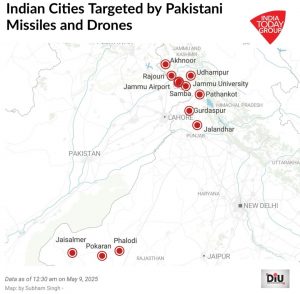
The message came after the Air Force repulsed two waves of drone and missile attacks by Pakistan targeting Indian military installations in Jammu and Kashmir, Rajasthan, and Punjab.
India’s Air Defence Masterclass: Repelling Pakistan’s Missile and Drone Attacks Amid Escalating Tensions
New Delhi, May 9, 2025 — In a dramatic escalation of the India-Pakistan conflict, the Indian Air Force has successfully repelled two major waves of drone and missile attacks launched by Pakistan. These strikes, which targeted Indian military installations in Jammu and Kashmir, Rajasthan, and Punjab, were swiftly intercepted by India’s advanced air defence systems, showcasing the nation’s military preparedness and technological edge.
Sources confirm that India’s airspace remains fully under control, protected by a sophisticated network capable of detecting, jamming, and eliminating threats before they breach national boundaries. This clear message is directed not only at Pakistan but also at hostile non-state actors who may seek to destabilize the region.
Pakistan’s Retaliation After India’s Operation Sindoor
The attacks began late on May 7, mere hours after India launched Operation Sindoor — a high-precision airstrike that destroyed nine terror camps in Pakistan and Pakistan-occupied Kashmir (PoK). The operation, India’s response to the deadly Pahalgam terror attack, saw the deployment of 24 advanced munitions, including the SCALP long-range missile and the HAMMER smart bomb, within a 25-minute strike window.
Pakistan’s retaliatory drone and missile barrage targeted military bases in or near 15 Indian cities. However, India’s layered defence, including the integrated counter-unmanned aerial system (C-UAS) and Israeli-made HARPY drones, effectively intercepted the incoming projectiles. Notably, HARPY drones also launched counterattacks, disabling key Pakistani air defence units.
A second wave followed just hours later, but once again, India’s air defences — this time leveraging the indigenously developed Akash missile defence system (comparable to Israel’s Iron Dome) — successfully repulsed the assault. According to defence sources, not a single Pakistani missile or drone reached its target, underlining India’s rapid, coordinated, and highly effective military response.
India’s Air Defence Arsenal: S-400, Akash Missiles, and Cutting-Edge Drone Tech
At the heart of India’s successful defence is its multi-layered air defence system, which integrates some of the world’s most advanced technologies. Among these is the Russian-made S-400 missile defence system, widely regarded as one of the best globally. India ordered five S-400 units from Russia in 2018 at a cost of ₹35,000 crore; three have been delivered and are now fully operational along the Pakistan and China borders, with two more due by 2026.
India also boasts the homegrown Akash missile system, which has been repeatedly compared to Israel’s Iron Dome due to its proven ability to intercept and neutralize incoming threats. Complementing these systems is India’s deployment of anti-drone and counter-UAS technologies, essential in modern warfare where unmanned aerial vehicles play an increasingly prominent role.
The recent counterstrike on a China-supplied HQ-9 air defence unit stationed in Lahore further demonstrated India’s offensive reach and technological precision. Defence analysts suggest this crippling of Pakistan’s air shield could leave the country vulnerable to future aerial operations, heightening the stakes in the ongoing conflict.
Strategic and Diplomatic Implications
While military action has dominated headlines, the international community has expressed grave concern over the escalating India-Pakistan hostilities. Global powers, including the United Nations, the United States, and China, have called for immediate de-escalation, warning of catastrophic regional consequences should tensions spiral further.
India’s precision strikes under Operation Sindoor, coupled with its successful missile and drone defences, send a powerful signal of military capability and strategic preparedness. Yet, behind these battlefield victories lies the urgent need for diplomatic solutions to prevent a broader conflict — especially given the nuclear capabilities on both sides.
India’s Message: Airspace Secure, Nation Vigilant
The Indian government has assured its citizens that the nation’s airspace is secure, thanks to an air defence network designed to neutralize threats before they breach borders. “Our rapid and coordinated response system guarantees the safety of critical military installations and civilian areas alike,” a senior defence official told NDTV.
State governments have been advised to maintain high alert, particularly in border states, while intelligence agencies work round-the-clock to monitor both internal and external security threats.
Looking Ahead: High-Stakes Security and the Need for Peace
As the situation unfolds, India continues to showcase its formidable defence capabilities, but the international community hopes that both India and Pakistan will choose diplomatic pathways over prolonged conflict. With two nuclear-armed nations facing off, the stakes could not be higher.
For now, India’s rapid military response, advanced air defence systems, and successful cross-border strikes have reasserted its dominance in a volatile theatre. But whether this marks a turning point toward resolution or further escalation remains to be seen.