
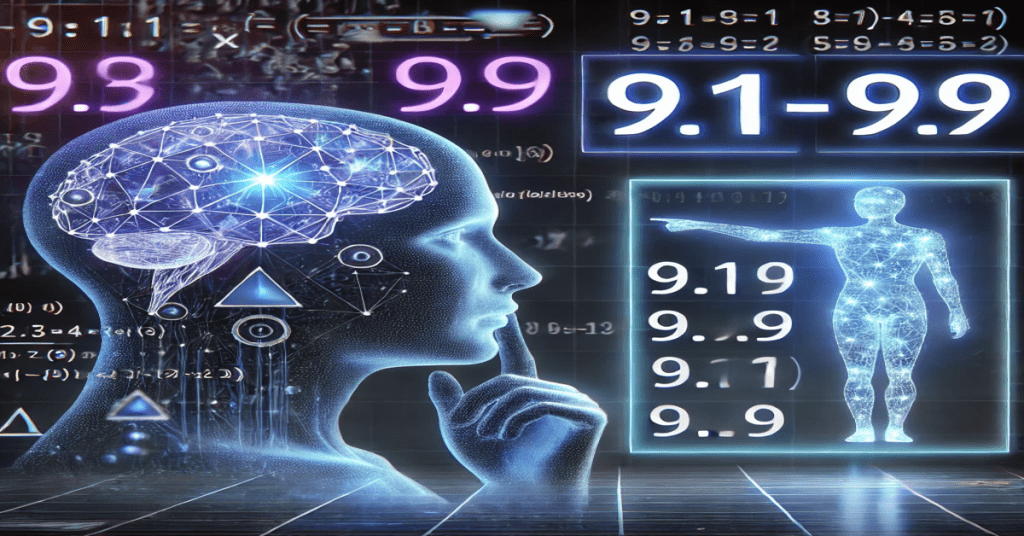
AI vs. Human Number Sense
If you ask a person whether 9.11 or 9.9 is larger, they’ll confidently say 9.9 wins. But if you ask an AI—whether ChatGPT, Claude, or MetaAI—you might get a shocking answer: some models insist 9.11 is bigger.
Why does this happen? Is AI bad at math, or is there a deeper reason? In this article, we’ll explore:
- Why AI number comparison can be flawed
- The surprising ways AI interprets numbers differently from humans
- Whether we should trust AI’s judgment over our own
Let’s dive in.
Why AI Thinks 9.11 > 9.9
At first glance, this seems like a glaring error. But AI doesn’t “think” the way humans do—it processes data based on patterns, not innate logic. Here’s why some models get this wrong:
1. Version Numbers (Software Logic)
In software development, version 9.11 comes after 9.9 (because it’s 9.11, not 9.1.1). If an AI was trained on coding data, it might default to version numbering rather than decimal math.
2. Date Format Confusion (MM/DD vs. Decimals)
- September 11 (9/11) is later than September 9 (9/9).
- If the AI was exposed to date comparisons, it might interpret 9.11 as a date rather than a decimal.
3. Lexical (Alphabetical) Ordering
When sorted as text, “9.11” comes after “9.9” because “11” follows “9” in alphabetical order. Some AIs default to string comparison instead of numerical value.
4. Training Data Bias
If AI was trained on datasets where 9.11 frequently appeared in a “larger” context (e.g., software versions, dates, or IDs), it might generalize incorrectly.
The Bigger Problem: AI Lacks Common Sense
This isn’t just about numbers—it’s about how AI processes information differently from humans.
The “Strawberry” Parallel
Ask an AI: “How many ‘R’s are in ‘strawberry’?” Many models answer “two” (when it’s actually three). This happens because:
- AI predicts text statistically, not analytically.
- It doesn’t “count” like humans—it guesses based on patterns.
Why Humans Win at Basic Logic
Humans have innate number sense—we automatically recognize decimals, count letters sequentially, and apply real-world logic. AI, however, relies on probabilistic reasoning, leading to confidently wrong answers in edge cases.
Should We Trust AI’s Judgment?
If AI can’t reliably compare 9.11 and 9.9, should we still trust it for complex tasks?
The Case for AI Superiority
- AI outperforms humans in data analysis, language translation, and pattern recognition.
- Maybe our insistence that 9.9 > 9.11 is just a human bias—what if AI sees a deeper truth?
The Case for Human Oversight
- AI lacks common sense reasoning.
- It can be confidently incorrect in ways humans would never be.
- For now, human verification remains crucial.
How to Get Better Answers from AI
If you want precise numerical answers from AI, try:
- Rephrase the question:


- Specify the format:
- Use step-by-step prompting:

FAQ: AI and Number Comparisons
1. Can AI models be trained to avoid this mistake?
Yes! Developers can fine-tune AI models to handle decimal comparisons correctly by emphasizing numerical data interpretation during training.
2. Why does AI sometimes get math wrong despite its computing power?
AI processes text probabilistically rather than using strict arithmetic logic unless explicitly programmed to do so.
3. Do all AI models make this mistake?
No, more advanced models (e.g., GPT-4, Claude, and Gemini) have improved logic but may still fail in specific contexts depending on their training data.
Conclusion: AI’s Quirks vs. Human Logic
AI’s “mistake” reveals a fascinating truth: it doesn’t think like us. While humans rely on instinctive number sense, AI relies on statistical patterns—leading to bizarre errors in simple tasks.
Does this mean AI is flawed? Not necessarily. But it does mean we should:

And if AI ever declares “2+2=5,” maybe we should at least hear it out… before correcting it.
Internal Links:
External Links (Dofollow):


